Create a Fractional Factorial Design in Python
Learn to create efficient fractional factorial designs using pyDOE3: reduce experiment costs while maintaining statistical power through strategic confounding and resolution optimization.
Read More Learn to create efficient fractional factorial designs using pyDOE3: reduce experiment costs while maintaining statistical power through strategic confounding and resolution optimization.
Read More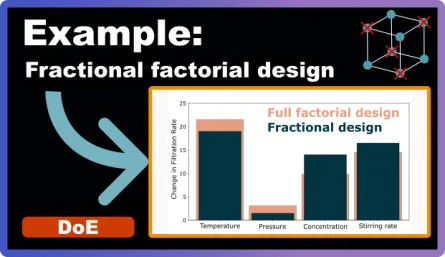
A step-by-step walkthrough of a fractional factorial design: why, when, and how to use it, with a practical example and visualizations.
Read More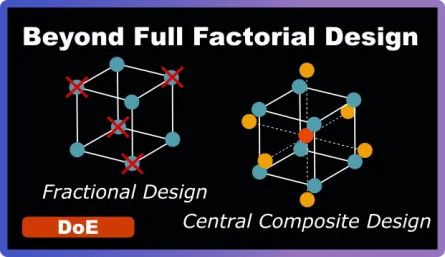
When to move past full factorial design; how to use fractional designs to screen and central composite designs to optimize.
Read More
Step-by-step guide for beginners: install pyDOE3, create 2^k designs, add factor names, map to real units, randomize, and export ready-to-run experiment plans.
Read More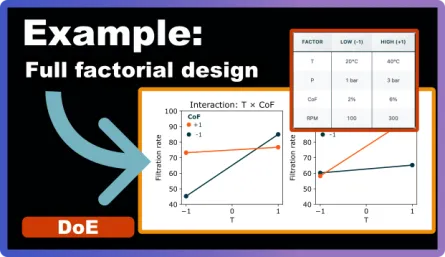
Learn what a full factorial design looks like in practice and how to create and analyze one—using a real filtration-rate dataset. We’ll read main-effects and interaction plots without heavy stats.
Read More
Discover why one-factor-at-a-time (OFAT) approaches miss crucial interactions and how systematic design space coverage leads to full factorial designs. Learn to plan experiments that capture maximum information with minimal runs.
Read More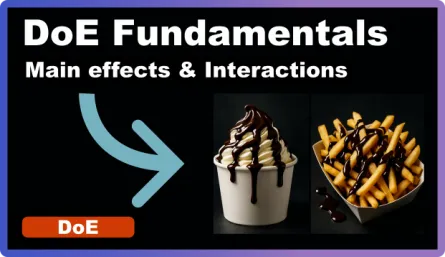
Understand main effects and interaction effects in factorial design. Learn how factors can work independently or synergistically in Design of Experiments through practical examples and visualization techniques.
Read More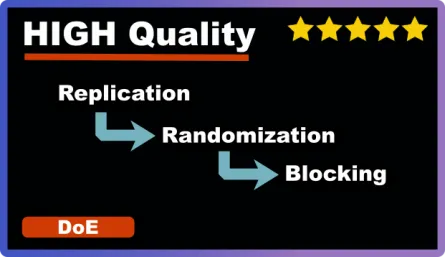
Learn the three fundamental principles of Design of Experiments that ensure high-quality, reproducible data: replication, randomization, and blocking. Essential DoE basics for reliable experimental results.
Read More
Your essential cheat sheet for Design of Experiments terminology. Learn the key terms like factors, factor levels, response variables, and more to master DoE conversations and concepts.
Read More